 TFStudio
 Predicting the Color of Coated Glass
Turn a coating's spectrum into a CIE color. See why AR coated lenses have purple tint.
A coated lens held up to the light shows a color in reflection, often a faint purple, blue, or green, while what you see through it looks clear. That color is not a coating on top of the coating. It is the reflectance spectrum itself, turned into a color by your eye.
This tutorial takes three designs that are already published here: bare glass, a two-layer V-coat, and a four-layer broadband AR coating. For each one it asks the same question: what color does it show, in reflection and in transmission?
The conditions
Color is not a property of a coating alone. It depends on the light source and on whose eye is looking, so those have to be fixed before any number means anything. Throughout this article:
- Illuminant: CIE standard D65 (average daylight)
- Observer: CIE 1931 2° standard observer
- Angle of incidence: 0° (normal)
- Polarization: unpolarized (s/p average)
- Reflected color is computed from one coated front surface (R), the same single-surface convention as the design articles.
- Transmitted color is computed from the whole 1 mm plate (T), including both surfaces and the substrate, evaluated incoherently.
- Spectra are sampled over 380–780 nm; the color integral uses a 5 nm step.
Change the illuminant or the observer and the numbers move. D65 and the 2° observer are the common default and the one used here.
From a spectrum to a color
The eye has three cone types, so any spectrum collapses to three numbers. The CIE formalizes this with the tristimulus integrals:
Here is the illuminant, is the coating's reflectance (or transmittance) as a fraction, and are the color-matching functions. The constant is chosen so that for a
perfect diffuser, which makes:
- , the luminance factor: how bright the reflection or transmission is, in percent. It is essentially the luminous (eye-weighted) average of the spectrum.
- The chromaticity , derived from , the hue and saturation, meaning the color independent of brightness.
Two further numbers make the color easier to name:
- Dominant wavelength: the pure spectral color the eye reads the hue as.
- Excitation purity: how far the color sits from white, as a percentage. Low purity is near-grey; high purity is vivid.
A design can have a very low (a dim reflection) and still have high purity (a saturated hue). That combination is what a strong AR coating produces, and, as the next section shows, a hue can be so dim that it reads as black until something bright is reflected in it.
Bare glass: a neutral grey reflection
Let's check the color characteristics of 1 mm thick BK7 Glass plate. Uncoated BK7 reflects about 4.2% at every visible wavelength.
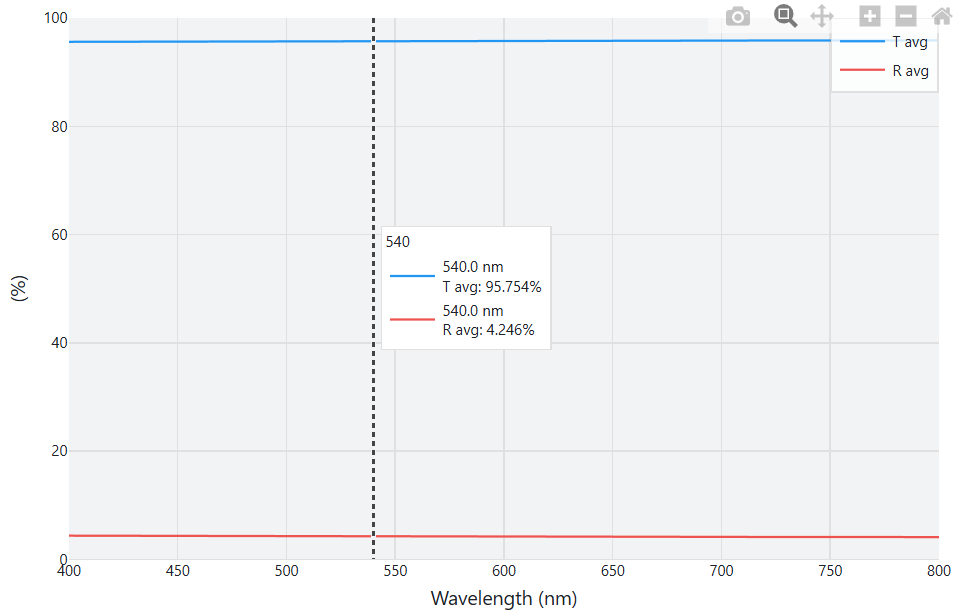
Because the spectrum is nearly flat, the reflected light keeps the color of the source: a dim, essentially neutral grey.
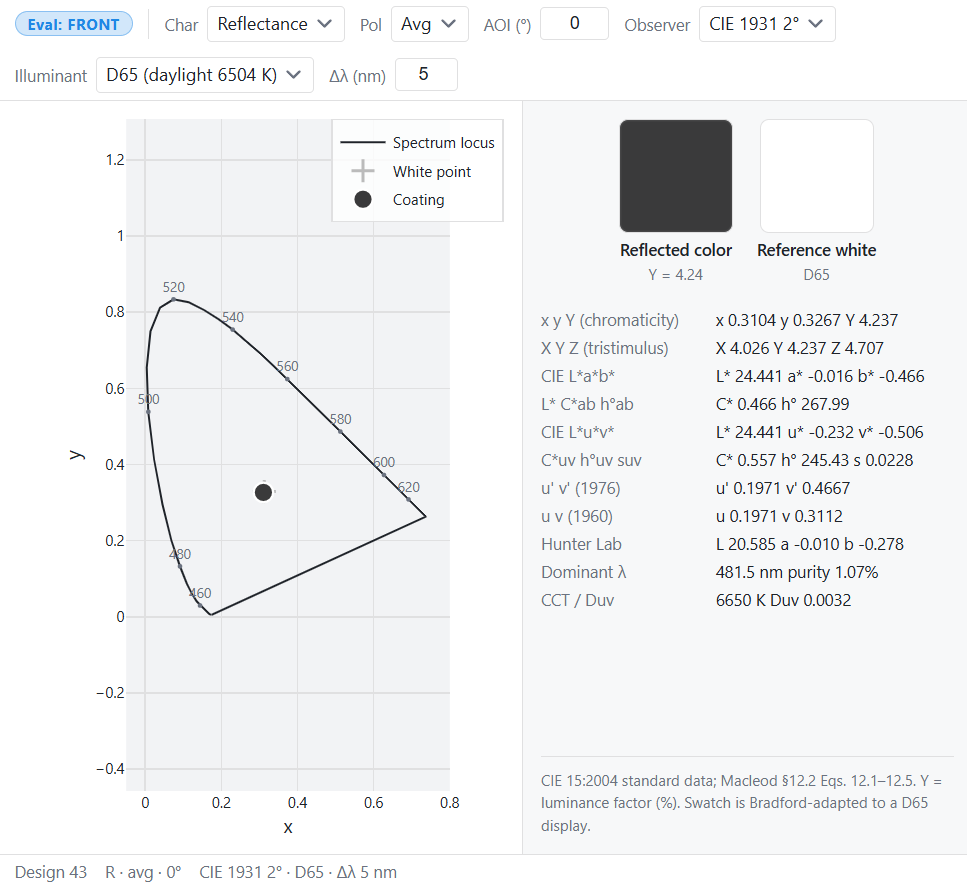
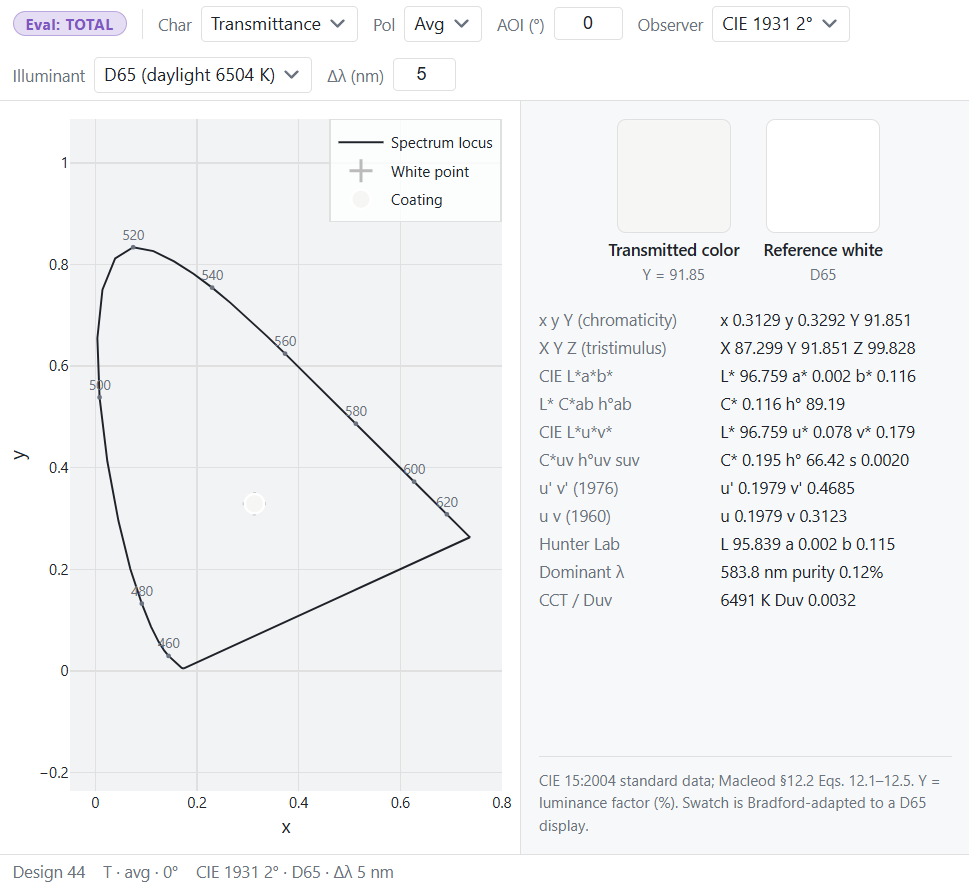
| Quantity | Reflected (one surface) | Transmitted (total) |
|---|---|---|
| Luminance factor | 4.24% | 91.85% |
| Chromaticity | 0.3104, 0.3267 | 0.3129, 0.3292 |
| CIE | 24.441, −0.016, −0.466 | 96.759, 0.002, 0.116 |
| Dominant wavelength | 481.5 nm | 583.8 nm |
| Excitation purity | 1.07% | 0.12% |
The D65 white point is at . Both of bare glass's colors sit almost exactly on it: purity is near zero. Reflection is a dark grey only because is low, not because it is colored. Transmission is a bright, essentially colorless white.
The broadband AR coating: a saturated violet, too dark to see
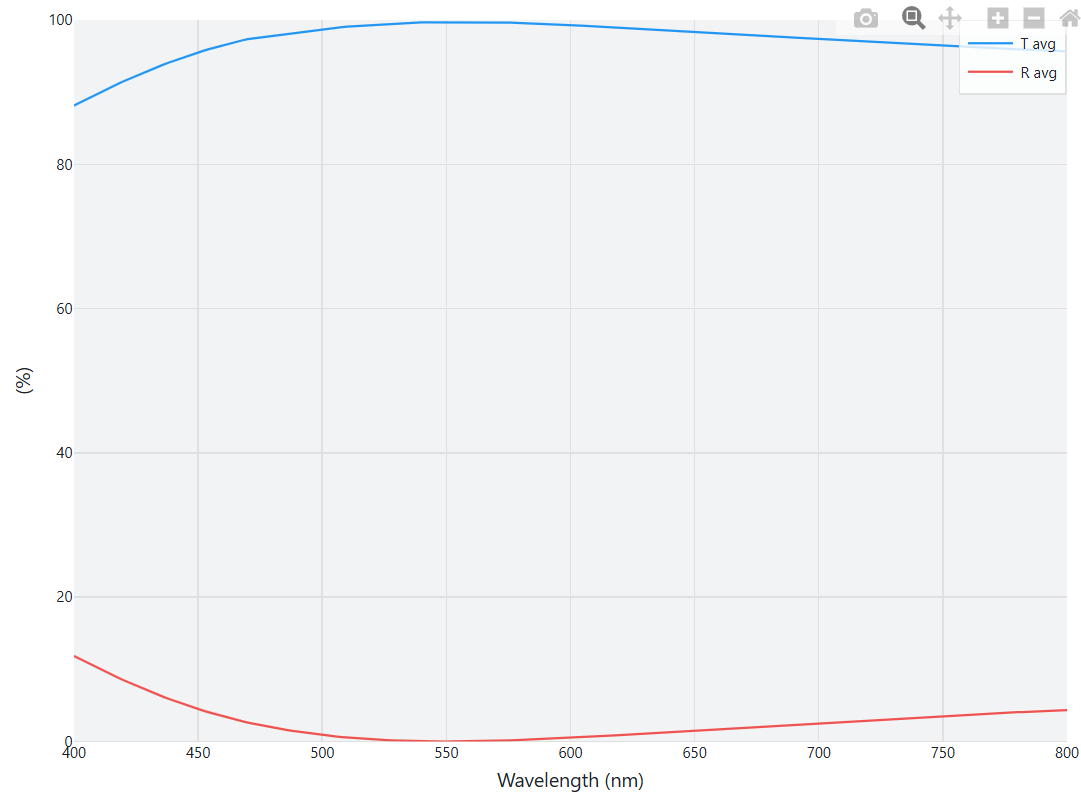
The four-layer coating holds front-surface reflectance below about 0.3% across 450–650 nm, but the residual reflection is not flat. It climbs steeply toward the blue and, less sharply, toward the red:
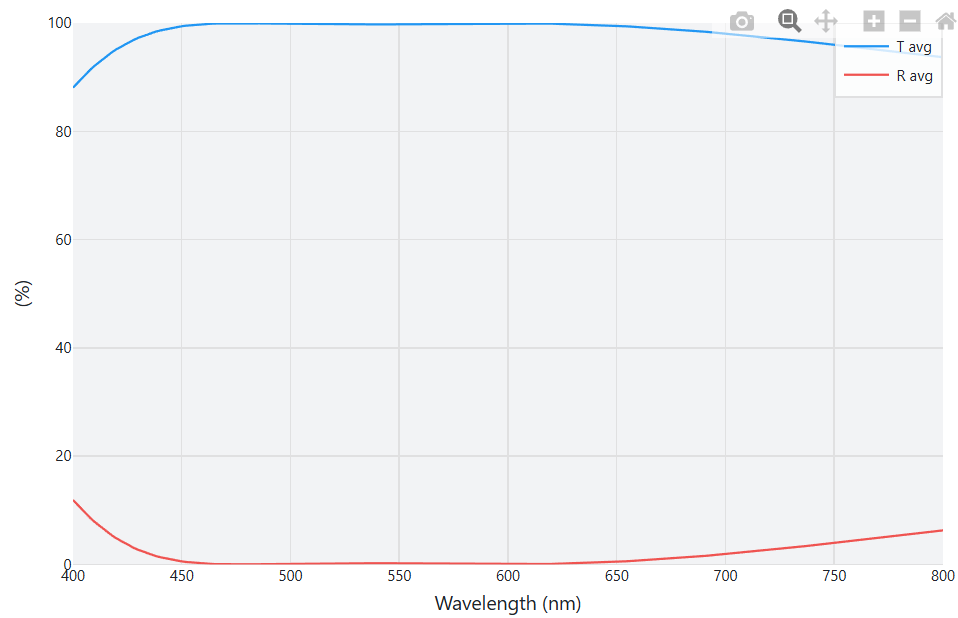
| Wavelength | Coated surface R |
|---|---|
| 400 nm | 6.34% |
| 450 nm | 0.29% |
| 500 nm | 0.08% |
| 550 nm | 0.10% |
| 600 nm | 0.01% |
| 650 nm | 0.26% |
| 700 nm | 0.97% |
The eye integrates this, but weighted by its own sensitivity, which peaks in the green near 555 nm and is nearly blind in the deep blue. So the 6.34% spike at 400 nm adds almost nothing to the luminance ; what it does is set the hue. It pushes the chromaticity far out toward the violet corner of the spectral locus, to a dominant wavelength of 449 nm and 73% purity, while the luminance stays near zero.
| Quantity | Reflected (one surface) | Transmitted (total, one surface coated) |
|---|---|---|
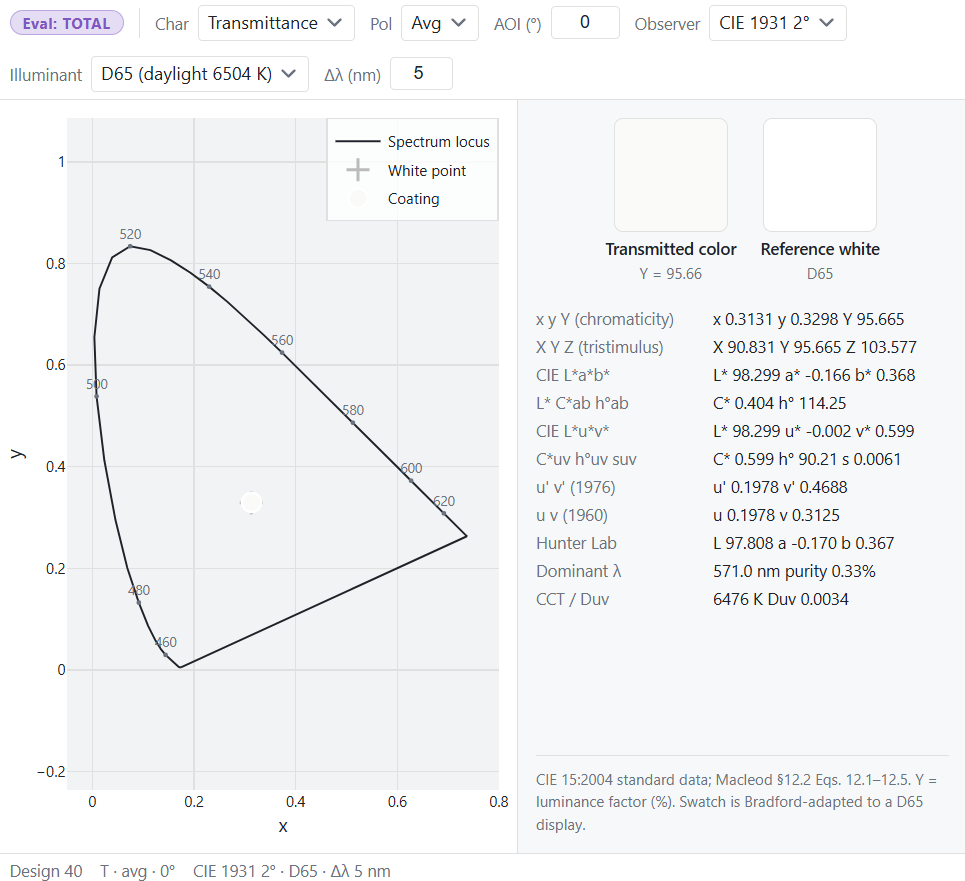
| Luminance factor | 0.085% | 95.665% |
| Chromaticity | 0.2045, 0.0962 | 0.3131, 0.3298 |
| CIE | 0.768, 4.097, −7.52 | 98.299, −0.166, 0.368 |
| Dominant wavelength | 449.1 nm | 571 nm |
| Excitation purity | 73.12% | 0.33% |
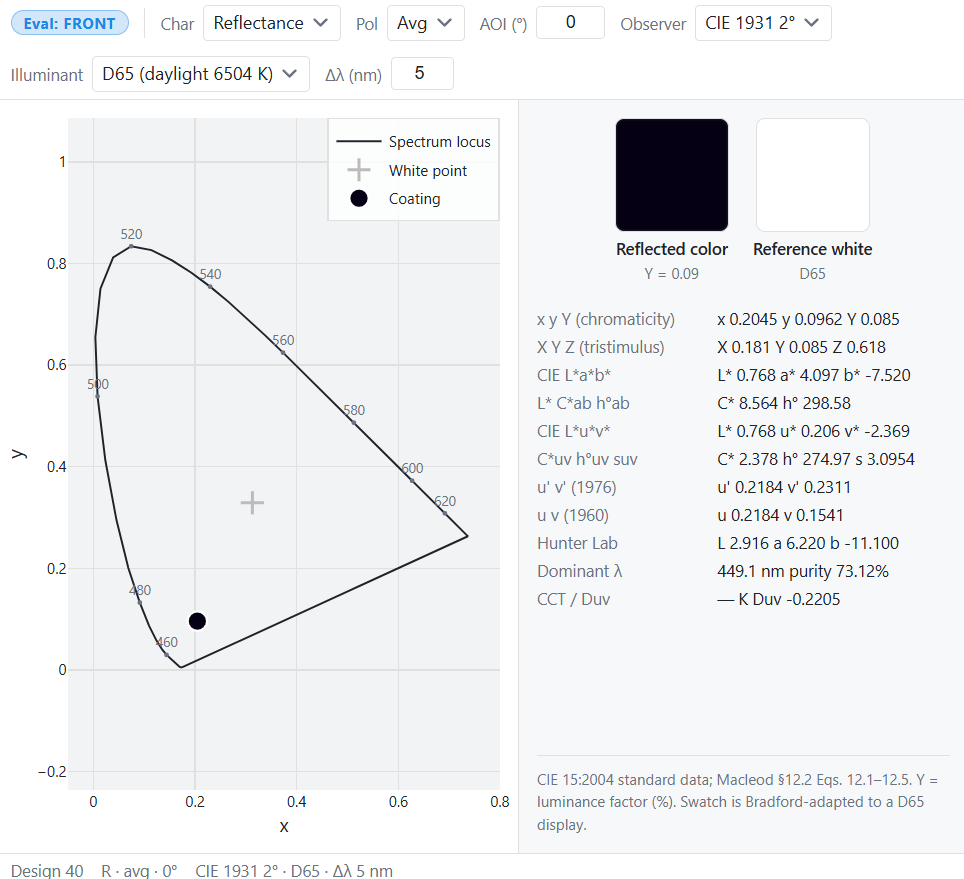
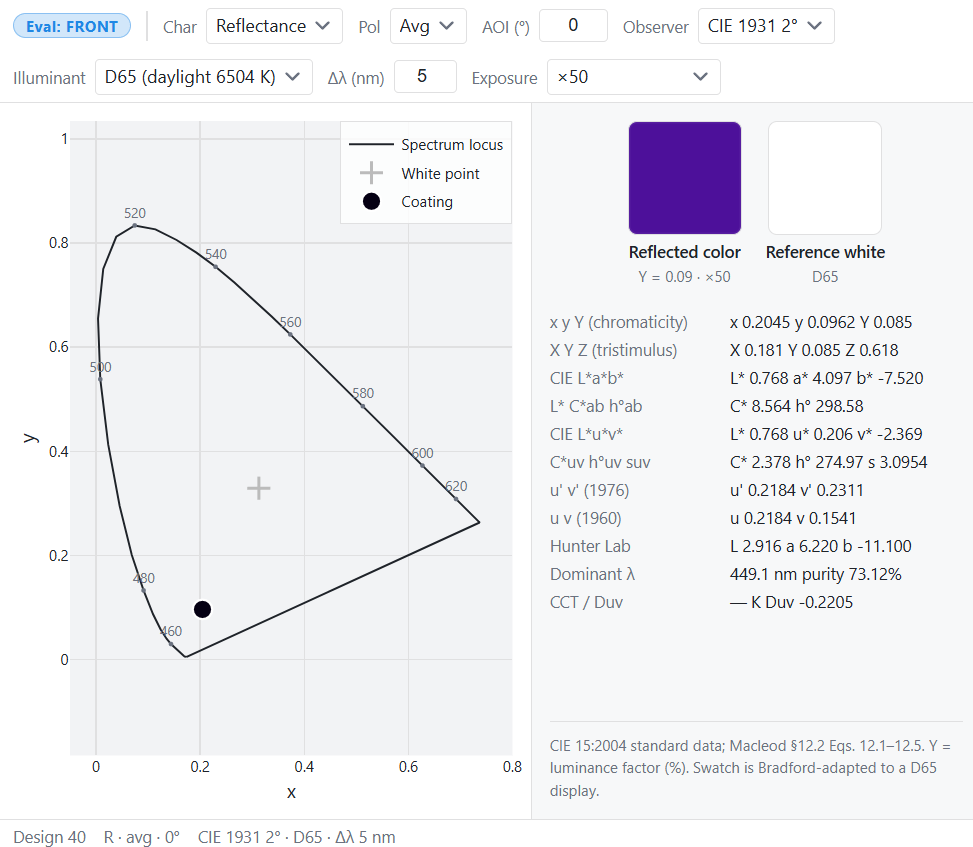
The chromaticity is a vivid violet, but the luminance is only , so the reflected-color swatch above is essentially black. There is almost no reflected light to carry the hue, and against a neutral background the eye sees near-black, not violet. Compared with bare glass the coating is about 50× dimmer in reflection ( 0.085% versus 4.24%) yet far more saturated (73% versus 1.1% purity). So that's what you'll see reflected in a dark room.
So why do real coated lenses so clearly look purple? Because you usually catch them reflecting a bright source: a window, a lamp, the sky. Even 0.1% of a bright light is enough for the eye to read the violet tint, and a real lens reflects from both of its surfaces at once. The hue in the swatch and the purple glint on a lens are the same chromaticity; what changes is how much light sits behind it. So if we bump up the exposure to 50x we'll see the purple tint.
The transmitted color, meanwhile, is a slightly brighter white than bare glass, because the coating sends more light through without tinting it.
The V-coat
The V-coat drives reflectance to nearly zero at 550 nm and rises on both sides. Its residual reflection is therefore missing its green and strongest at the blue and red ends.
| Quantity | Reflected (one surface) | Transmitted (total, one surface coated) |
|---|---|---|
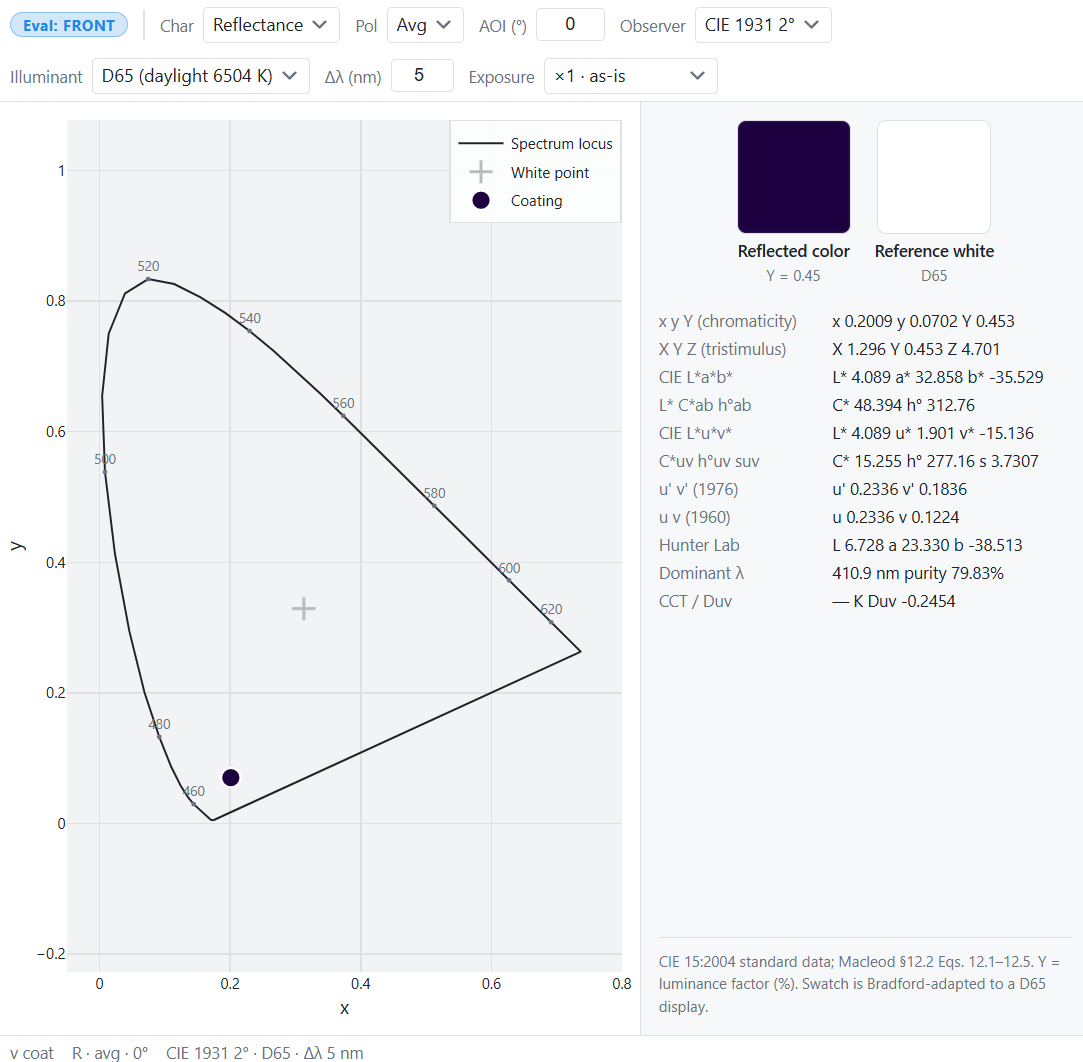
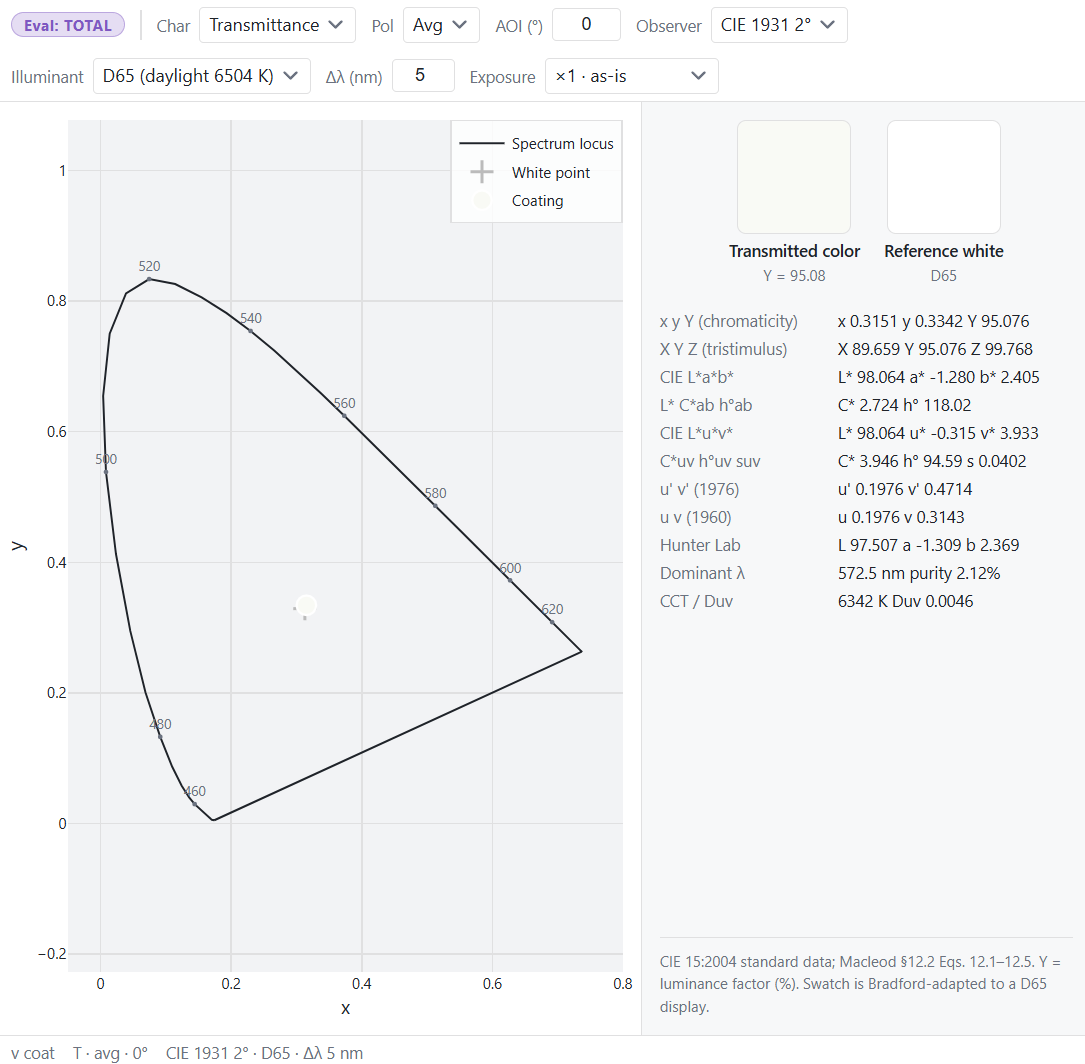
| Luminance factor | 0.453% | 95.076% |
| Chromaticity | 0.2009, 0.0702 | 0.3151, 95.076 |
| CIE | 4.089, 32.858, -35.529 | 98.064, -1.28, 2.405 |
| Dominant wavelength | 410.9 nm | 572.5 nm |
| Excitation purity | 79.83% | 2.12% |
Here we can see more saturated purple color even without exposure boost in reflected light:
And in trasmission this coating gives dimmer white:
Unfinished dielectric mirror
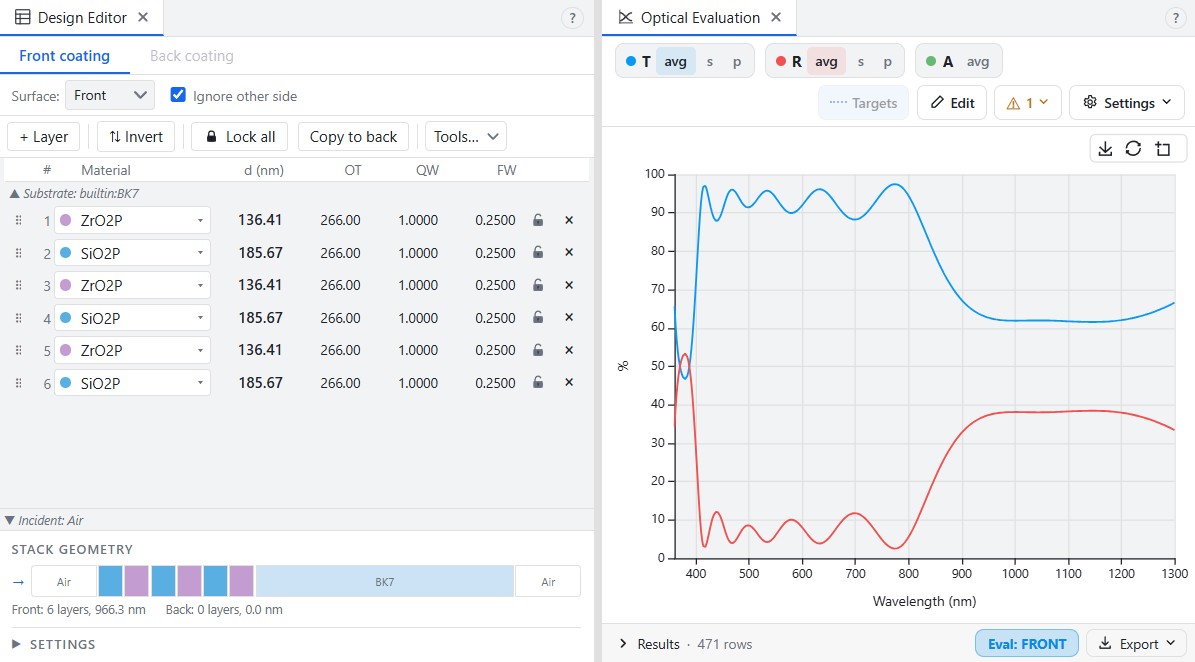
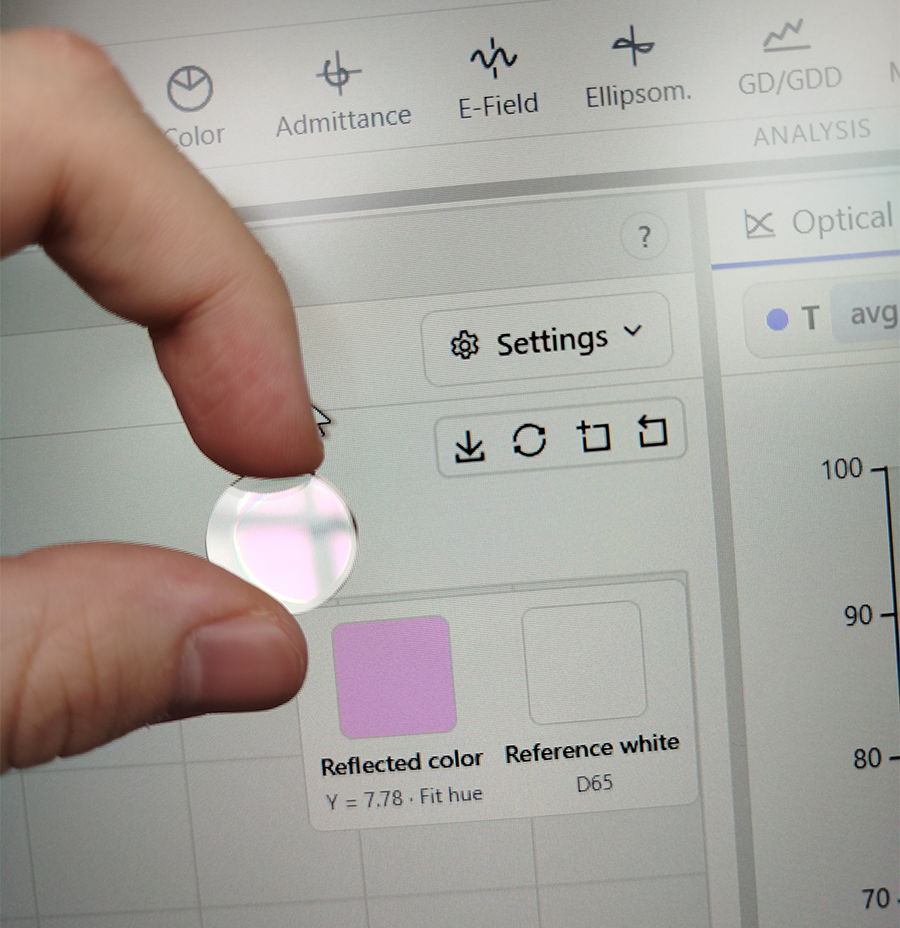
Here I took a photo of an unfinished dielectric mirror for 1064 nm with 6 layers deposited:
What this does and does not tell you
- The color is stated for D65 and the 2° observer at normal incidence. Under a different source, such as an incandescent lamp or a phone screen, or at an angle, the color shifts. Tilt in particular moves the AR minimum and changes the reflected hue, as covered in What Angle and Polarization Do to an AR Coating.
- Reflected color here is one surface. A real plate in air also reflects from its back surface, which adds a second, weaker contribution.
- A low luminance in reflection means little light is reflected, not that the surface is dark to look at; against a bright background the colored reflection is what you notice.